I was listening to a news report the other day about Washington state's child welfare system. They were interviewing a guy who works for the department that is responsible for children and families caught up in the foster care/adoption/preservation system. He was talking about the fact that the state of Washington now realizes that it's better to keep families together, if at all possible. Hallelujah, someone besides us has figured that out. The interviewer asked him why he thinks state and local departments are so quick to rip children away from their biological parents. He responded, "Fear." He admitted that no one wants to make the mistake of leaving a child in a truly dangerous home. He noted, however, that in 90% of the reported cases, children are taken away from their parents for issues related to poverty or general lack of parenting skills. Understanding this, the state of Washington has changed the role of social workers from that of gate keeper and watch dog to parent coach and supportive ally. Moreover, the state is shifting the resources from foster parenting to helping preserve the biological family. I wanted to cry; this is exactly what they should be doing. Because guess what, it's hard on children to break the bond they have with their biological families. It hurts, it's painful; it creates trust issues and unnecessary insecurities that were never present before the system intervened.
Not to mention, what happens to the millions of children who end up in foster care? The reality is that there are so few of us who really give a damn about them, who even give these innocent, young children a second thought. And while it would be nice to think that all of us become adoptive parents because we have always longed to be viewed as society's second class parents, the reality is that many of us chose to adopt out of a sense of obligation, a strong belief that we should give a shit about these kids. We care, and we can't stand the idea that there are children facing the world alone. People like us adopt everything: causes, cats, you name it. We have this internal voice that is constantly harassing, do more, be more, not enough. Let's be real, we're just special people. And while we're awesome, there are not enough of us to adopt every single child who the state has shoved into foster care.
The guy suggested that about 10% of children legitimately cannot be reunified with their biological parents. He acknowledged that for those children, the system needs to do a better job of identifying them when they are much younger. Additionally, he said that as soon as the state has identified the child, an adoptive home needs to be secured sooner than later. Of course, this would not be nearly as difficult were there less children unnecessarily languishing in the system. The employee went on to admit that finding adoptive homes for teenagers is extremely challenging. He noted that this is undoubtedly related to the fact that adopting teenagers is very difficult, for everyone. The teenager's biological clock is telling him or her to establish independence at the same time that the adoptive family is trying to bond. This is complicated on so many levels. Listening to him speak this truth, I almost started crying.
Yes, news flash, it's very hard to bond with teenagers. Teenagers by nature can't stand their parents. If they don't, there is likely something wrong with them. Like my mother has professed to have felt about me when I was a teenager, I wanted Malcolm and Mychael to establish their independence from me and to want to leave one day. Isn't that most parents' dream? But, the signals get so confusing when it happens at the same time that you are trying to form a permanent bond as a family. "Leave me alone, I can't stand it here, I can't wait to leave." How many times did we tell our parents this? Yet, when it comes from the mouth of a teenager who has just been adopted, it feels so different. The parents perceive the sentiments as rejection of them and the adoptive family. Meanwhile, the children are confused because while they want to be part of the family, they also want their parents to butt out and go away. In the end, everyone feels bad, like it's not working, like they messed up. And that sucks because it's all so normal!
The other day I was talking with Malcolm, who admittedly is struggling a little and who likely is doing so as a result of issues related to him not initially living the American dream. Yes, okay, we aren't perfect. We're still awesome, but we have issues. And no those issues do not justify us being considered second class, damaged family members. Anyway, Malcolm was talking about being depressed and his low self esteem issues. I can't remember exactly what preceded his comment, but I do remember what he said next, "Whenever I pull away or don't want to talk to anyone, it's not because I'm rejecting you or our family." I told him I knew that because in my heart I do. But, that's because it's been 18 years, and we have lived a lot of life, I mean A LOT OF LIFE since then.
I remember that when I first adopted the kids, I wasn't so sure that they wanted to be a part of our family; I didn't appreciate the complexity of the situation. In retrospect, I know that whether I chose to admit it at the time, I often felt insecure. And unfortunately, those insecurities likely influenced some of my parenting strategies. "You see in others what you see in yourself," my mom likes to say. That is the truth. It's important to keep our insecurities in check and appreciate how they influence what we think is happening within our family. It's hard though because emotions are so powerful. Talk to your kids about how you are feeling because they are likely feeling the same way and will be relieved that there is a reason for it. Use this experience as a means to bond; we're in this fight together. Whatever you do, don't give up. When your emotions are trying to get the best of you, rely on what you know versus how you feel. Eventually the two will come together.


8.08.2013
Come Home Soon Malc!
Someone asked what was up with Malcolm. Well, I've been holding that information protectively because he's my little boy (who is turning 25 years old next month), and he is in Afghanistan, and that freaks me out. Yet, words truly cannot express how impressed and proud I feel when thinking and talking about my Malc. Instead of continuing to ask me to pay for his school, he decided that he wanted to be independent. He saw joining the military as a way to accomplish that goal. NOT the way I wanted him to accomplish it, but he made that decision on his own. I would gladly have found a way to pay for him versus having him go to Afghanistan, but he wanted to be independent and handle things on his own. Every time I talk to him, I'm am in awe of how much my little Malc has grown up. He is truly becoming an amazingly compassionate, insightful and strong young man. He will be home in November and WE CANNOT WAIT! He's proven himself to be much braver than I have ever been. So proud of him!
Here is a photo of him with his girlfriend. I cannot believe how awesome the women are that my sons have in their lives. I know a lot of normal families, and their sons don't have girlfriends even half as awesome as my sons'. Did I mention Malc's girlfriend is adopted? Does it get any better than that? Oh yes, keeping it as far from normal as possible! Just how we like it. This is what a real family looks like.

Here is a photo of him with his girlfriend. I cannot believe how awesome the women are that my sons have in their lives. I know a lot of normal families, and their sons don't have girlfriends even half as awesome as my sons'. Did I mention Malc's girlfriend is adopted? Does it get any better than that? Oh yes, keeping it as far from normal as possible! Just how we like it. This is what a real family looks like.

8.03.2012
Stanley Gets Married!

12.30.2011
Waiting For That Perfect Ending

I have been waiting for that perfect ending in order to finish the adoption book that I started so many years ago. Things haven't turned out exactly as I'd planned and so I have waited. Currently, my sons are still finishing up college, with Malcolm having just over 30 credits and Mychael having sixteen credits to complete before earning their bachelor's degrees. In my mind, I have always viewed earning these degrees as the end goal. In retrospect, I'm not exactly sure why I thought a college degree would be the ultimate sign of success. Can I say they have been successful despite not having their degrees in hand?
Since graduating from high school, my sons have had many accomplishments along the way, accomplishments that I likely overlooked because they were intermixed with struggle. My kids were set up from day one to struggle, so why didn't I anticipate that they would, in fact, struggle? And if I wanted normal, I should have chosen the boring route, the path of the weaker ones--the biological ones :) I think it's harder for adoptive families to have setbacks because we are expected to fail and so we always feel like we have something to prove. I have never wanted people to know when my children struggle because I assume that they will think, "Yeah, we knew you couldn't make it." As a result, I always try to act as though everything is always wonderful. I'm not allowed to be upset because if I am, then I'll have admitted that they were right.
I have a few non-adoptive friends that I know see adoptive families as being just as legitimate as biological families, and as such, I feel safe confiding in them. Sometimes when I'm really stressed, I'll complain about something and they will say, "Are you kidding? I feel like that with my kids, and I gave birth to them!" I know my love for my children is as real any parents' love for their children. However, it feels good to know that it's okay to have times when I feel doubt, regret or frustration. You mean all parents sometimes fantasize about what life would have been like had they not had kids? Are you telling me that all parents have moments when they wish they could quit? Wait, and you can have all these feelings while simultaneously loving your children more than anything in the world? What? If it's hard for biological parents to admit this without feeling guilty, then it's next to impossible for adoptive parents.
Sometimes I get so tired of fighting against stereotypes and prejudices in order to just be viewed as a regular old family. Some days I just want to hate my role and not feel as though I'm letting down an entire population of people in doing so. I'm sick of always having to be better than normal just because society can't seem to wrap themselves around this notion that sharing superficial things like pigment, history and even DNA is not a pre-requisite to unconditional love and commitment. Imagine that, normal people, we adoptive families love, sacrifice and remain committed when confronted with "normal" family challenges even though we don't all necessarily look the same! Aren't we cosmopolitan!
Recently, I was talking to Malcolm about the fact that he is allowed to take steps in life at the pace in which he feels most comfortable. While he didn't necessarily take the exact route I would have taken, we haven't exactly had the same early experiences. And wasn't I the one advocating that my children be allowed to have control in their lives? Shouldn't I be okay with the fact that they are exercising their right to call the shots on their terms? Only recently have I humbly realized that this also includes me not getting to call the shots. It's hard to be a young person trying to establish oneself in the adult world. My role is to support my sons' efforts to do this effectively.
So why does the perfect ending mean that at age 22, they would have already graduated from college and be working in the post-graduate workforce? I think the answer to that has a lot more to do with me than it does with them. While I might always feel like we have something to prove to the society, my sons just want to be allowed to be themselves and to be accepted 100% for the choices that they make, even if they don't necessarily coincide with what everyone else thinks they should be doing. If I remember correctly, I'm pretty sure I felt the same way when I was their ages. Hmm, this all sounds so familiar, so normal. I guess I'm still learning, and whether I like it or not, they are still teaching.
7.06.2011
It's Been Too Long!


First off, let me say thanks for the emails, and yes, we're still alive! It's been a super busy last year. I've actually been trying to get some of my own things going after many years of only focussing on Mychael and Malcolm. All parents know what that's like. It's been a tough couple years for Mychael and Malcolm. They have struggled with figuring out what they want to do with their lives. I think that's normal for all young adults. However, I think it's even more difficult for people who were older when they were adopted. Early adulthood is all about figuring out who you are and what you want to do with your life. I think that a lot of older adoptees get stuck on that "who you are" part.
That said, I believe that they are finally finding peace with themselves and their future paths seem to be opening up for them. Frankly, I'm still looking for my future path, so I'm not all that concerned that they have been, too. In the coming months, I'm going to post some direct correspondence from them. I think it's time for them to give their side of the story. In fact, I think it would be therapeutic to do so.
In terms of the book, I have yet to finish it. I've been waiting for that "happily ever after" ending. (You know what I mean, the final chapter that explains how everything went perfect and we ended up exactly where we thought we would.) Then one day recently I realized that I'm not even sure what that ending looks like. Is it the ending in which both my sons are college graduates, financially established and professionally employed? Is it when my sons are happy, content, in good relationships and in general at peace with themselves? Can you have all those things at once (I know this biological child hasn't)? I finally decided that "happily ever after" really means "okay with how things are going and optimistic about the future". In that case, I guess we're there.
That said, I guess I'll be wrapping up the book (finally). I decided that I'll end the book by interviewing my kids. Again, therapeutic for them and informative and helpful to anyone, especially families, fortunate enough to be in the presence of an adopted child or adult. Anyone have something they'd like to ask? Email me or leave a note on the blog, and I'll be sure to include it. I hope all of you amazing people are still being the incredibly wonderful humans that you are. I'm so thankful for adoptive families. Every time I meet an adoptee or adopter, I feel such a strong bond. I feel connected in a way that I simply cannot have with biological families. I had that experience lately and it reminded me how much I treasure adoptive families. Because seriously, we are the best...so normal!
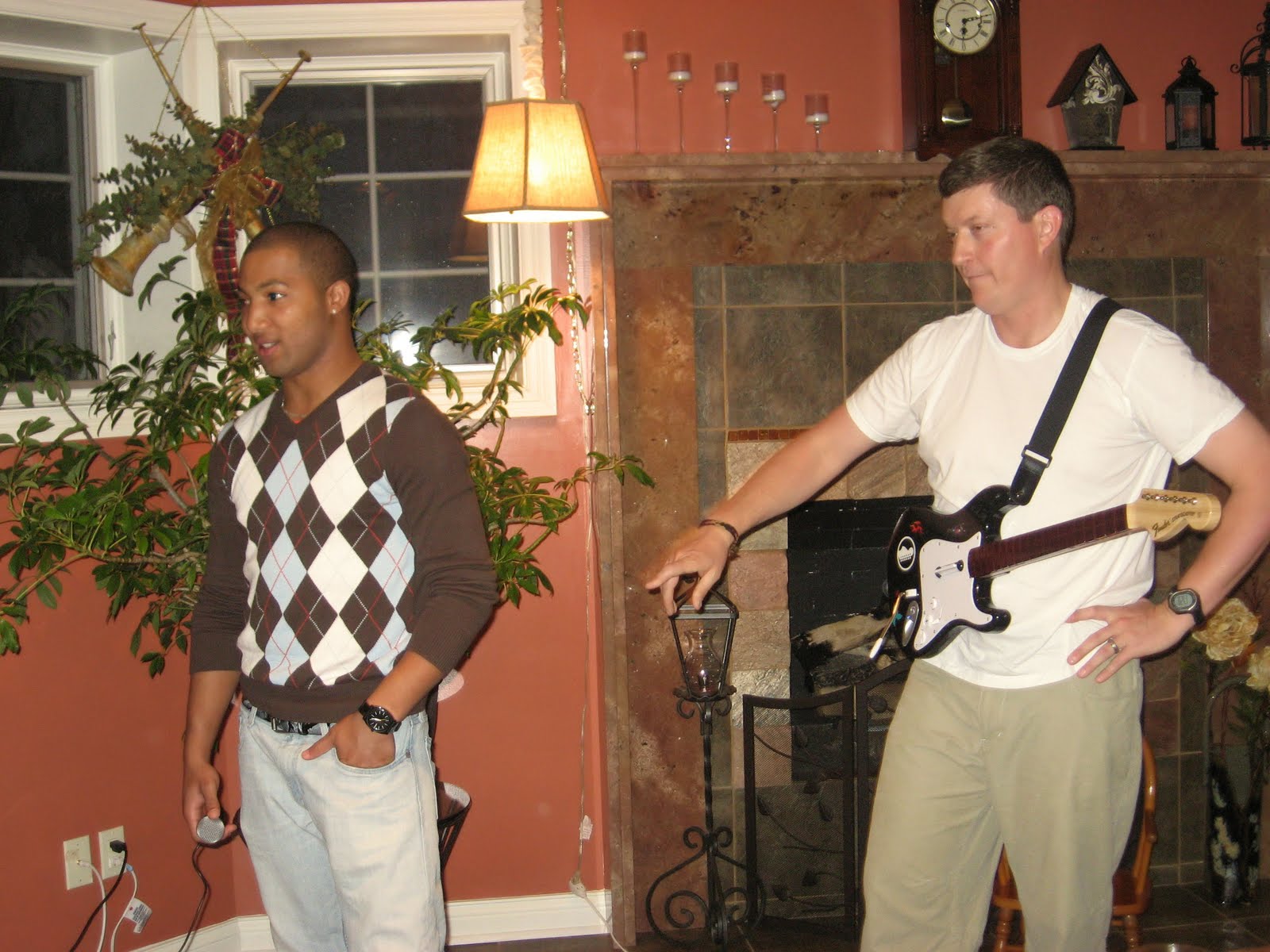
Here we are talking a walk.
9.12.2010
Happy 22 Malcolm!
Malcolm turned the big 22 on Friday...he's getting all grown up!

I just wanted to acknowledge that it's been a while since I've written. To say the least, I have gotten away from the blog for quite some time. I was overwhelmed with self imposed challenges, and didn't have the emotional energy to put myself out there. Specifically, I picked up where I left off, career wise, when I adopted the kids many years ago, and doing so had consequences. I'm learning how to find the balance between being Gretchan and being Mychael and Malcolm's Mom. I read something one time in which Moms were asked to describe the emotions that they often experienced as Mothers. One word was consistently repeated by all the women--Guilt. Mom's overwhelmingly feel guilty when they focus on anything other than their children. We feel guilty about everything. When our children suffer, we feel as though we somehow inadvertently caused it. When they fail, we wonder what we should have done differently. When they hurt, we hurt. It's hard to find that balance.
For most of us, parenting means that you are ready to sacrifice just about everything (including your sanity) for the sake of your kids. Parenting is the hardest job in the entire world. You don't get a minute off, and this notion that once your kids become adults, you're off the hook is delusional at best. People warned me about the intensity of this whole parent thing, but I didn't listen. I was naive. And thank God for that. And by the way, are these sentiments enough to prove that I'm worthy of being perceived as a real Mother? Are these emotions genuine enough that people might actually refer to my children as my real kids? Am I legitimate now? Nah, but whatever. You can't have it all.
Regardless, we hit a few speed bumps over the last year. Yet, we pulled through...are pulling through just like we always do. And in the end, I have no doubt that we'll say that we're better people for having been forced down the alternate path yet again. But whatever, I'm not sure if I'd even recognize the regular route anyway. My normal is the alternate route. Sure, sometimes you dream of taking the easy route--to just for once have the opportunity for things to just work out the first time you try, and for everyone to just do their part. Yet, for may of us, it's not who we are.
When you get through the stress and start to see light at the end of the tunnel, you once again convince yourself that you didn't want it to be easy anyway. Soldiers like us can't survive when it's too easy. We get soft and weak. It's survival of the fittest and we are the survivors. Darwin says that the strongest are those that prevail in the face of the most adversity. So, bring it.

I just wanted to acknowledge that it's been a while since I've written. To say the least, I have gotten away from the blog for quite some time. I was overwhelmed with self imposed challenges, and didn't have the emotional energy to put myself out there. Specifically, I picked up where I left off, career wise, when I adopted the kids many years ago, and doing so had consequences. I'm learning how to find the balance between being Gretchan and being Mychael and Malcolm's Mom. I read something one time in which Moms were asked to describe the emotions that they often experienced as Mothers. One word was consistently repeated by all the women--Guilt. Mom's overwhelmingly feel guilty when they focus on anything other than their children. We feel guilty about everything. When our children suffer, we feel as though we somehow inadvertently caused it. When they fail, we wonder what we should have done differently. When they hurt, we hurt. It's hard to find that balance.
For most of us, parenting means that you are ready to sacrifice just about everything (including your sanity) for the sake of your kids. Parenting is the hardest job in the entire world. You don't get a minute off, and this notion that once your kids become adults, you're off the hook is delusional at best. People warned me about the intensity of this whole parent thing, but I didn't listen. I was naive. And thank God for that. And by the way, are these sentiments enough to prove that I'm worthy of being perceived as a real Mother? Are these emotions genuine enough that people might actually refer to my children as my real kids? Am I legitimate now? Nah, but whatever. You can't have it all.
Regardless, we hit a few speed bumps over the last year. Yet, we pulled through...are pulling through just like we always do. And in the end, I have no doubt that we'll say that we're better people for having been forced down the alternate path yet again. But whatever, I'm not sure if I'd even recognize the regular route anyway. My normal is the alternate route. Sure, sometimes you dream of taking the easy route--to just for once have the opportunity for things to just work out the first time you try, and for everyone to just do their part. Yet, for may of us, it's not who we are.
When you get through the stress and start to see light at the end of the tunnel, you once again convince yourself that you didn't want it to be easy anyway. Soldiers like us can't survive when it's too easy. We get soft and weak. It's survival of the fittest and we are the survivors. Darwin says that the strongest are those that prevail in the face of the most adversity. So, bring it.
9.11.2010
From Mom To You

The other day my oldest son Mychael said, "Why haven't you been writing on the blog?" I was really surprised that he had been following it. Frankly, the lack of enthusiasm he demonstrated when I originally told both Mychael and Malcolm about it led me to think that this blog was the least of their concerns. Yet, apparently I was wrong, so if you are reading this, Skippy, I'm writing this entry just for you.
I know you didn't ask me to say this, and I am not overanalyzing! I was just thinking, and I have a couple things I want to make sure that you know. In fact, I know you know it, but I just want to say it out loud in case you ever forget. I know it's been a little different over the past year due to the fact that we're in different places. However, despite the fact that I moved and after ten years, I have taken some time to focus on my career, you should know that the sun continues to rise and set on our little family. There are a few things in this world that you can always count on, and this family is one of them. It's hard making that emotional transition from being at home to being on your own. We worry that people will forget about us when we're gone. We worry that somehow things will change and not be the way they were before. We worry that leaving somehow means the end, instead of the beginning.
Yet, even though I know you know this, I just want to say that moving forward doesn't mean that we leave our family behind. Instead, we go out and face the world knowing that our family always has our back. Our family is always in the background cheering for each other. Whenever we feel nervous or scared, we can just turn around and know we'll still be there. Even if every person and everything we encounter in our new path is rotten, we will be able to cope with it because we always have each other. A family is still a family even when they are not together. We are still a family when one person lives on one coast and the other lives on another. The bond of a family is never broken.
So, in your new adventures...in my new adventures, and in the new adventures of all Team Thompson, we find comfort knowing some things never change. No matter where we are, we know that I'm still clearing my throat while being obsessive about something; you, Jay and Shawn are still being sensitive about most everything; Malcolm is still trying to escape in order to hang out with friends; Mamaw is still trying to hold everyone and everything together; Paul is still relaxing on the perimeter and trying to stay awake; Maudie Moo is still laying down in the middle of it; Esther Sue is still hiding; Alysia is still trying to make it all fit in a neat box; Grandma T. is still perfectly wonderful; Joe is still talking about how its all a conspiracy; Grandpa is still trying to avoid conflict and Grandma Jill is still...well, you know, Grandma Jill.
So, we should not worry that leaving means things will change. In fact, it's September, and we know what that means: Purdue Football. So, here's to another season of watching our faithful Boilers blow the lead in the final minutes of the game. And yet, we still love them, right? Because at least we always know what to expect and that has to count for something.
Love you little pumpkin head,
Mom
Purdue Boilermakers...

Two sensitive guys...

Team Thompson's newest Boilers...

5.11.2009
Happy Mother's Day!
We spent most of Mother's Day rocking the world.
The night before, I returned from Philadelphia to find Mom, Paul, the kids and some of Mom's wonderful neighbors and friends hanging in the living room. "That was really fun," reported Mychael the next day.

The night before, I returned from Philadelphia to find Mom, Paul, the kids and some of Mom's wonderful neighbors and friends hanging in the living room. "That was really fun," reported Mychael the next day.

4.27.2009
The Little Guy Turns 24!


Mychael turned 24 this weekend!! I made everyone get in the back seat of the car in order to take pictures. It was hot, so the kids didn't want to take them outside. Regardless, I reminded the kids that Mychael is only one year younger than I was when I adopted them. Mychael said, "Yeah, and I'm going to adopt a little White girl next year."
Obviously Mychael won't be doing any adopting anytime soon. However, it will be validating once the kids get to the age I was when I adopted them. Maybe then they'll realize how hard it was to live, let alone raise teenagers, and cut me some slack. I guess I'm lucky that I will have waited only eleven years and fourteen years for that validation whereas biological parents have to wait a whole lot longer! Yet another reason to adopt older children.

Alysia (aka: Easter Bunny) gave me the above magnets for Easter. She wanted Malcolm to look younger, but didn't realize he'd look quite so young. Malc didn't care. He thought it was pretty sweet either way. I like the fact that Maude and Esther were also included.
4.26.2009
Free At Last, Free At Last, Thank God Almighty, Free At Last!
When I first adopted the kids, it would have helped greatly to know that someone else had gone through feelings and experiences similar to ours. I receive a lot of email from people saying the same things. The reality is that there are a lot of unexpected things that come up, but in the end, you manage them, conquer them and come out stronger. I just want you to know that whatever you experience, you're not alone. There are thousands of us out here who've been there, or are there on a daily basis. At the end of the day, the family is what matters--the kids, and no amount of craziness will feel more powerful than the bond you share with your family.
(Freeing Mychael from Polinsky (San Diego's Children's Home). The beginning of our Real Family.)
On Saturday morning, bright and early, I drive to Polinsky. I’m excited about today, but also nervous. I park in the same spot that I always park in and walk the forty six steps that it takes to reach the building. Since it’s Saturday, a lot of the Polinsky inmates will be spending the day with their families. The lucky ones might even get to leave for the entire weekend.
I hit the buzzer beside the door.
“Yes?” answers the attendant.
“I’m here to pick up Mychael Moore?”
“And you are?” the voice asks suspiciously.
“Gretchan Thompson.”
I can hear her flipping through papers. Pleeaassee let my name be on there, I think.
“I don’t see your name on this list; are you his social worker?” she interrogates.
Damn, they’re not going to let me take him.
“Charlene was supposed to call and tell you I was picking him up today. She’s his social worker. I’m his foster parent.”
The buzzer goes off signaling that I’ve been granted access. I pull the door open and step inside the first set of doors. I wait for her to buzz me into the next set. Once she does, I walk up to the window so she can get better look at me.
“I found your name,” she says over her shoulder as she digs through a mound of papers.
“Great,” I declare happily.
She turns toward me, tilts her head and comes closer. Surely you’ve seen stranger things than a foster parent, who looks like she’s 16?
“Just sign here to say that you’re taking him. Are you bringing him back? No wait-it says he’s not returning. That means we’ll need to have him gather his belongings, too. Let me call back there,”
She picks up the phone. “Boys Wing 2, please call intake,” she says over the intercom.
I pace nervously in front of the window. I feel like I’m doing something wrong, and I’m nervous that they’re not going to let me take him. I can only imagine how the biological parents, “the perpetrators”, feel when they come to visit. I’m the good one, and I’m afraid they are going to back out of their agreement and not let me have my kid.
After ten minutes of worrying that they are going to figure out they’ve made a mistake and not let me have him, I see Mychael walking up from the back. He’s managed to successfully clear the two sets of security doors between the boy’s dorm and the reception area. Only a little farther Mychael, don’t make any sudden moves, just keep walking.
I put on a big smile as he walks toward me with a black trash bag in each hand. “Looks like you’ve got all your stuff. Let me carry one of those,” I say, reaching out my hand to him. He hands me a bag, and I turn back to the nurse at intake to make sure we’re still cool with all this.
“These are his current medical requirements and the forms you’ll need to take to the dentist and doctor. Make sure that these are filled out and sent back to us at this address. This is part of his medical passport history,” she says as though that means something to me.
I nod so she thinks I know what she’s talking about. You never know-this could be a deal breaker. “Okay, so does he have something he needs to do right away?”
“Yes, he’s got four root canals in process. He had those started when he was here two years ago, but they never got finished. He needs to get in to have them finished sooner than later,” she declares pragmatically. This is nothing to her. She’s seen worse than four root canals on a 14 year old.
“Do I have to take him to the same dentist? Where is his dentist? Who is his dentist?” I ask, trying to look like I’m calmer than I feel. If she knows I’m scared, she might not let me take him.
“We don’t care what dentist you take him to, as long as you take him somewhere. Here’s the information,” she says, handing me another stack of forms.
“Okay, great then…I’ll get right on that,” I promise.
“Don’t forget to take those yellow forms with you when you go to the appointment.” she says, pointing to the yellow forms on top of the stack of papers she’s just handed me. “People are always forgetting to take the forms and then we don’t know what medical care or dental care the kids have had when they come back here.”
“I won’t forget the forms, though Mychael’s coming home for good. He won’t be back here ever again,” I declare confidently.
She gives me a huge, toothy smile. I can’t tell if she’s smiling because she’s happy that Mychael will have a permanent home or if she’s smiling because she thinks I’m naïve, as of course he’ll be back. “I hope you’re right. Good luck to you both,” she says as she presses the button to grant us access to the outside world.
“Free at last, free at last. Thank God almighty, free at last,” I say to Mychael as he takes his first forty six steps of freedom.
(Freeing Mychael from Polinsky (San Diego's Children's Home). The beginning of our Real Family.)
On Saturday morning, bright and early, I drive to Polinsky. I’m excited about today, but also nervous. I park in the same spot that I always park in and walk the forty six steps that it takes to reach the building. Since it’s Saturday, a lot of the Polinsky inmates will be spending the day with their families. The lucky ones might even get to leave for the entire weekend.
I hit the buzzer beside the door.
“Yes?” answers the attendant.
“I’m here to pick up Mychael Moore?”
“And you are?” the voice asks suspiciously.
“Gretchan Thompson.”
I can hear her flipping through papers. Pleeaassee let my name be on there, I think.
“I don’t see your name on this list; are you his social worker?” she interrogates.
Damn, they’re not going to let me take him.
“Charlene was supposed to call and tell you I was picking him up today. She’s his social worker. I’m his foster parent.”
The buzzer goes off signaling that I’ve been granted access. I pull the door open and step inside the first set of doors. I wait for her to buzz me into the next set. Once she does, I walk up to the window so she can get better look at me.
“I found your name,” she says over her shoulder as she digs through a mound of papers.
“Great,” I declare happily.
She turns toward me, tilts her head and comes closer. Surely you’ve seen stranger things than a foster parent, who looks like she’s 16?
“Just sign here to say that you’re taking him. Are you bringing him back? No wait-it says he’s not returning. That means we’ll need to have him gather his belongings, too. Let me call back there,”
She picks up the phone. “Boys Wing 2, please call intake,” she says over the intercom.
I pace nervously in front of the window. I feel like I’m doing something wrong, and I’m nervous that they’re not going to let me take him. I can only imagine how the biological parents, “the perpetrators”, feel when they come to visit. I’m the good one, and I’m afraid they are going to back out of their agreement and not let me have my kid.
After ten minutes of worrying that they are going to figure out they’ve made a mistake and not let me have him, I see Mychael walking up from the back. He’s managed to successfully clear the two sets of security doors between the boy’s dorm and the reception area. Only a little farther Mychael, don’t make any sudden moves, just keep walking.
I put on a big smile as he walks toward me with a black trash bag in each hand. “Looks like you’ve got all your stuff. Let me carry one of those,” I say, reaching out my hand to him. He hands me a bag, and I turn back to the nurse at intake to make sure we’re still cool with all this.
“These are his current medical requirements and the forms you’ll need to take to the dentist and doctor. Make sure that these are filled out and sent back to us at this address. This is part of his medical passport history,” she says as though that means something to me.
I nod so she thinks I know what she’s talking about. You never know-this could be a deal breaker. “Okay, so does he have something he needs to do right away?”
“Yes, he’s got four root canals in process. He had those started when he was here two years ago, but they never got finished. He needs to get in to have them finished sooner than later,” she declares pragmatically. This is nothing to her. She’s seen worse than four root canals on a 14 year old.
“Do I have to take him to the same dentist? Where is his dentist? Who is his dentist?” I ask, trying to look like I’m calmer than I feel. If she knows I’m scared, she might not let me take him.
“We don’t care what dentist you take him to, as long as you take him somewhere. Here’s the information,” she says, handing me another stack of forms.
“Okay, great then…I’ll get right on that,” I promise.
“Don’t forget to take those yellow forms with you when you go to the appointment.” she says, pointing to the yellow forms on top of the stack of papers she’s just handed me. “People are always forgetting to take the forms and then we don’t know what medical care or dental care the kids have had when they come back here.”
“I won’t forget the forms, though Mychael’s coming home for good. He won’t be back here ever again,” I declare confidently.
She gives me a huge, toothy smile. I can’t tell if she’s smiling because she’s happy that Mychael will have a permanent home or if she’s smiling because she thinks I’m naïve, as of course he’ll be back. “I hope you’re right. Good luck to you both,” she says as she presses the button to grant us access to the outside world.
“Free at last, free at last. Thank God almighty, free at last,” I say to Mychael as he takes his first forty six steps of freedom.
Subscribe to:
Posts (Atom)

 Posts
Posts